




Artificial intelligence is no longer sitting on the edge of the smart home conversation as a vague future trend. For many Connected Design readers, it has already part of their everyday professional lives. In our latest Industry Pulse Survey, which asked custom integrators, designers, builders, manufacturers, and other industry professionals how they are using AI in their current workflows, the most important finding may be the least sensational one: Adoption is real, but the approach is practical.
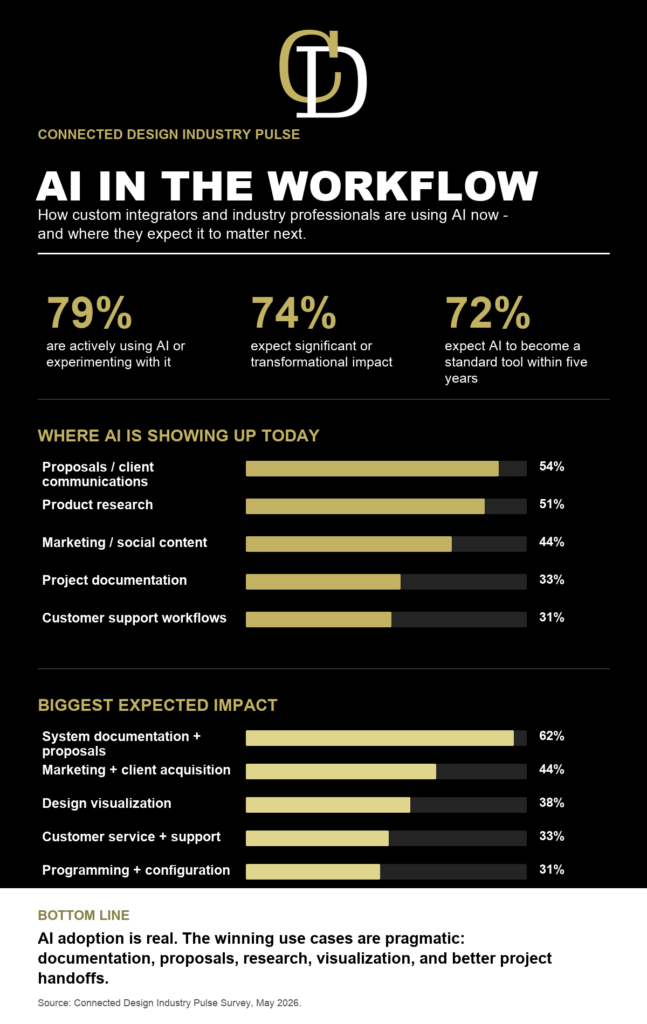
Among survey respondents, 79 percent said they are either actively using AI tools in daily workflows or experimenting with them. Only 10 percent said they are not using AI at all. That does not mean the industry has settled on a single approach, a preferred platform, or a fully trusted AI operating model. Rather, it suggests that the question has shifted from whether AI will touch the business to where it can create the most immediate value.
Language, Research, and Documentation
The most common current use cases are not deeply automated design systems or autonomous programming engines. They are the everyday areas where integrators and designers already spend considerable time translating knowledge into something useful for clients, teams, and projects.
REGISTER: Connected Design AI Roundtable
More than half of respondents said they are using AI for writing proposals or client communications (54 percent). Product research was close behind at 51 percent, followed by marketing or social media content (44 percent). Project documentation (33 percent) and customer support or service workflows (31 percent) also ranked strongly.
That pattern matters. It shows that AI is first being adopted as a drafting, summarizing, organizing, and research assistant. In other words, the earliest value is not replacing the judgment of the professional. It is helping professionals move their judgment into proposals, emails, documentation, and customer-facing materials faster.
Design visualization and concept rendering, at 26 percent, and programming or automation logic, at 18 percent, are present but less common. Those numbers suggest a more cautious path for technical or highly visual use cases, where the cost of being wrong or off-brand can be higher.
General-Purpose Tools Are Carrying the First Wave of AI Adoption
The current AI stack is still broad and general-purpose. ChatGPT was the most widely used tool, cited by 64 percent of respondents. Claude followed at 44 percent, while AI features built into design software were selected by 26 percent.
Other tools, including Perplexity, Gemini, Microsoft Copilot, and custom or proprietary AI tools, appeared in smaller shares. This mix suggests that the industry is still adapting mainstream AI assistants to specialized work rather than relying on a mature category of smart-home-native AI platforms. That presents a clear opportunity for vendors, software developers, and service providers. If professionals are already using general-purpose tools to draft proposals, research products, and organize project information, the next question is what happens when those tools become more closely tied to the systems, workflows, product catalogs, documentation standards, and service expectations of the custom integration channel?
Biggest Need: Documentation and Proposals
When respondents were asked where AI could have the biggest impact on the smart home design and integration process, one area rose above the rest: system documentation and proposals. It was selected by 62 percent of respondents, making it the strongest category in the survey. Marketing and client acquisition followed at 44 percent, while design visualization was selected by 38 percent. Customer service and support came in at 33 percent, and both programming/configuration and project management were selected by 31 percent.
The same theme appeared when respondents were asked which AI-driven capability would be most valuable to their business. AI-assisted documentation and proposals ranked first, selected by 28 percent of respondents. Smart home configuration tools followed at 21 percent, with automatic system design suggestions at 13 percent and automated troubleshooting or service diagnostics at 10 percent.
For an industry built around complex projects, client trust, product knowledge, and clean handoffs, documentation is often where expertise becomes operational. It is also where workflow drag accumulates. The survey suggests that AI’s strongest near-term value may be in reducing that drag, especially around proposals, specifications, records, and service support.
Confidence, Not Job Fear, Slows AI Adoption
The survey also complicates a common assumption about AI adoption: that the biggest barrier is fear of being replaced. In this sample, that was not the dominant concern.
Seventy-nine percent of respondents said they are not concerned that AI will replace their role or a significant portion of their day-to-day work. The barriers they identified were more practical, like uncertainty about how to use AI effectively, which was cited by 31 percent of respondents. Concerns about accuracy followed at 23 percent, and lack of time to learn the tools came in at 18 percent.
Several open-ended responses reinforced that mix of curiosity and caution. One respondent noted that AI “could be the future of the industry,” while also observing that the tools are “changing so quickly that it can be difficult to know what is best for a business.” Another pointed directly to accuracy and cost, writing that many AI products “still leave a lot to be desired.”
For integrators and designers, that caution is not surprising. In a client-service business, a confident-looking wrong answer can create real risk. An incorrect product recommendation, incomplete documentation, or mistaken configuration note can damage trust quickly. The survey suggests that wider adoption will depend less on convincing professionals that AI is interesting and more on helping them use it reliably, efficiently, and in context.
A High-Impact Future on a Short Timeline
Even with those reservations, respondents expect AI to reshape the industry. Seventy-four percent said AI will have either a significant or transformational impact on the smart home industry in the next five years. Only one respondent expected minimal impact.
Respondents also expect AI to change collaboration. Ninety percent said they expect AI to change the way integrators and designers collaborate on projects, with 44 percent saying it will do so significantly and 46 percent saying it will do so somewhat.
The timing is equally notable. Nearly half of respondents, 49 percent, said they expect AI to become a standard tool in the smart home design and integration process within one to two years. Another 23 percent said within three to five years, while 21 percent said it already is. Taken together, those findings point to a market that is not fully settled but is moving quickly. Professionals may be cautious about accuracy, training time, and fit, but they largely expect AI to become part of the standard workflow.
