


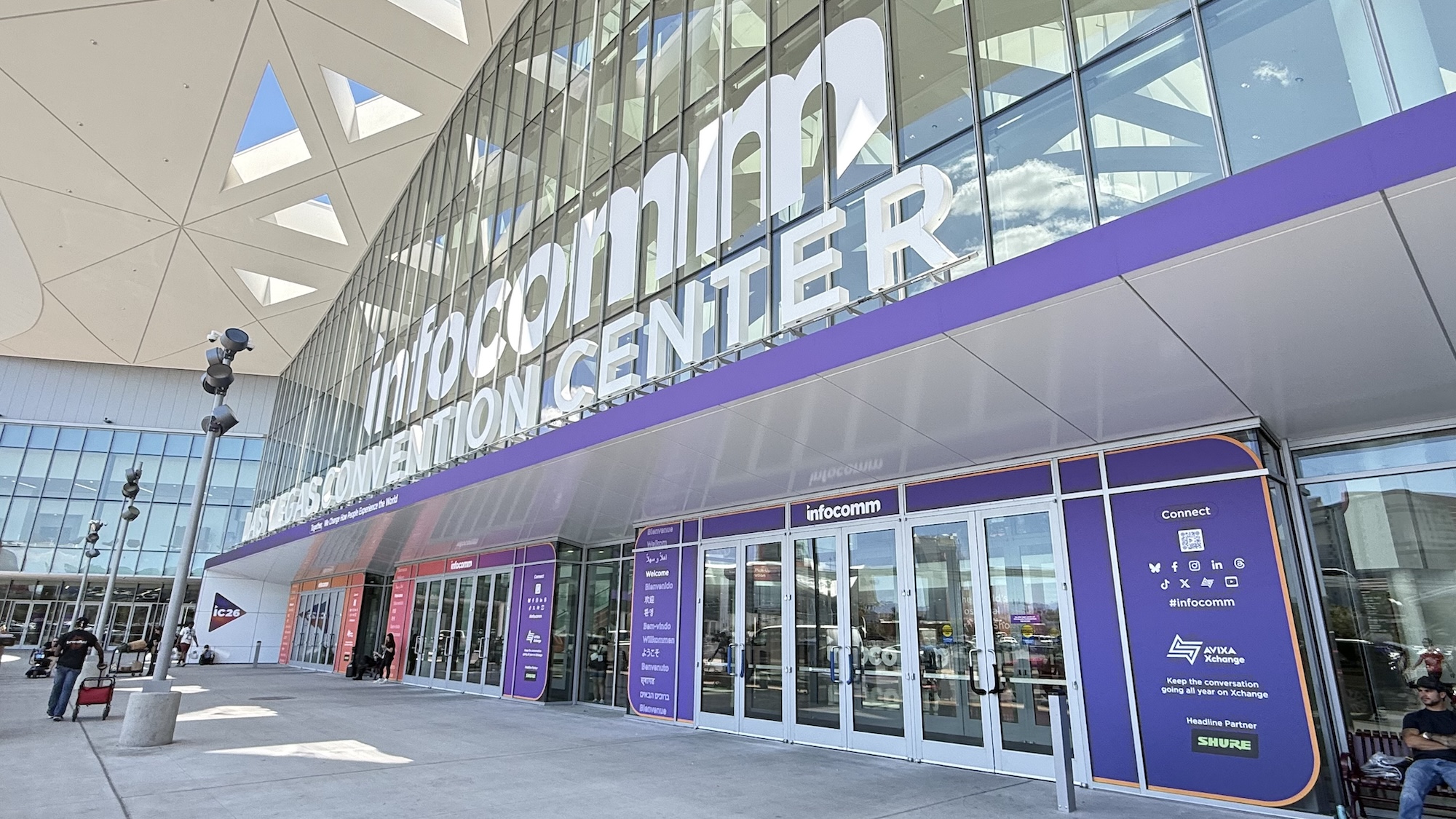

The commercial AV industry has never lacked for new boxes. The InfoComm show floor is built on them: displays, speakers, cameras, switchers, control interfaces, mounts, processors, and a long tail of supporting gear. But the strongest signal from this year’s InfoComm 2026 press cycle was not simply that manufacturers have more hardware to sell. It was that the industry is working hard to make AV feel less like a pile of components and more like a finished, managed environment.
That shift shows commercial AV is increasingly part of how a space presents itself. Whether we’re talking about boardrooms, classrooms, hotel lobbies, retail storefronts, restaurants, health care settings, or ginormous new arenas—they’re all judged not only by whether the technology within them works, but by how gracefully it supports the experience. The best systems are becoming easier to specify, cleaner to install, more intuitive to operate, and more connected to the business model of the places they serve.
While I might’ve been in and out of Vegas in a hot minute and prior to the show actually opening, a scan of the myriad releases and pitches that hit my inbox shows that a few themes rise above all the product noise.
Displays Are Becoming Finished Systems, Not Construction Projects
One of the clearest threads was the maturation of commercial display products into pre-engineered, easier-to-live-with systems. Sony’s Crystal LED UNIFY announcement described a 135-inch all-in-one direct-view LED display built around easier installation, simpler management, bright-space performance and a more blended design. That is a familiar direction across the category: the visual impact of LED without asking every project team to treat the display as a bespoke engineering exercise.
The same idea showed up in Philips Profession Display Solutions’ (PPDS) launch of its UltraSlim Philips Signage 7000 Series, positioned as a 4K UHD signage range that is up to 60 percent slimmer than comparable models and aimed at public venues, corporate, hospitality, food and beverage, education, transportation and security. LG, TCL, Epson, ALOGIC and others added to the broader picture with DVLED, all-in-one, projection and commercial display news around the show.
For integrators and design/build teams, the story is not just thinner bezels or brighter panels. It is a migration toward display systems that can be planned earlier, installed faster, and maintained more predictably. That makes large-format visual technology easier to bring into finished environments without letting the technology dominate the room.
AI Is Moving Into the Operating Layer
You didn’t think we were going to avoid talking about the most popular two letters out there today, did you? AI showed up in so many ways during the show and throughout press releases, but the more interesting examples were practical rather than theatrical. PPDS and BrightSign framed new signage around AI readiness. Barco’s InfoComm invitation pointed to AI-driven automation alongside projection, LED, image processing and collaboration. Sony’s InfoComm overview also tied its show story to imaging, PTZ and display innovation, including new SRG-AS10 and SRG-XS10 PTZ cameras.
The most telling direction, though, is AI as an assistant to operation. PTZOptics’ InfoComm messaging around visual reasoning and natural-language camera control pointed toward systems that understand context and respond with less manual intervention. Jabra’s booth invitation paired new video and audio solutions with Microsoft 365 Copilot workflows and voice-driven productivity demos. In other words: AI is starting to live inside the meeting, the camera moves, the signage updates, and the day-to-day management of a space.
Ultimately, there’s less thinking and less manual labor the client has to do when they walk into a space. Rather, the space does the thinking for them, prepping the environment for its intended use and removing the possibility of human error. Is it perfect? Not yet. But as these systems continue to learn and evolve, the closer to perfect we’ll get.
Managed Infrastructure Is Becoming the Business Model
Another strong signal came from companies framing AV as a connected service environment. ADI’s InfoComm release brought together audio, distribution, conferencing, control, automation, power, networking, remote management, services, surveillance, and security in one booth story. That language reflects where the channel is heading: fewer isolated product conversations and more complete solution stacks.
Custom Channels sharpened that point from the content and control side. Its Q-SYS Verified Plugin announcement brought licensed music into the AV control layer, while its in-store media platform pitch pointed to API-driven retail media, ad insertion, proof-of-play reporting, and fewer lock-in assumptions. Reddie’s pitch did something similar for digital signage, emphasizing POS-synced content updates, white-label opportunities, and reseller monetization.
Infrastructure stories showed up in the technical releases as well. Aurora’s Dante/AES67 over Wi-Fi announcement and INOGENI’s U-BRIDGE USB-C messaging both speak to the same pressure: modern spaces need flexible, networked, reliable signal paths that can support collaboration without turning every room into a cable management problem.
The Workplace Stack Keeps Collapsing Into One Experience
The old line between AV, IT, facilities, and workplace experience continues to blur. Jabra promoted new audio and video demos for rooms from huddle spaces to larger conference rooms, plus an under-embargo look at future headset news. Barco promoted ClickShare Hub bundles and a next-generation video conferencing room system. Joan’s pitch framed workplace technology around rooms, desks, visitors, digital signage, and e-paper badges.
The direction is easy to see: clients do not want separate experiences for meeting, presenting, booking, greeting visitors, managing desks, and showing content. They want a workplace layer that feels coordinated. For architects, designers, workplace consultants, and integrators, that means technology planning needs to happen earlier in the design conversation. The room is no longer finished when the furniture goes in; the experience layer is part of the room.
Retail, Hospitality, and Experience Venues Are Pulling AV Forward
A large share of the show messaging targeted customer-facing environments, not just traditional conference rooms. ADI’s demos spanned meeting spaces, retail, hospitality, restaurants, and bars. Philips Professional Displays called out public venues, stadiums, arenas, education, transportation, and hospitality. Custom Channels and Reddie both centered retail and restaurant use cases, tying AV to media networks, menu boards, licensed music, content control, and brand consistency.
This is one of the most important business implications coming out of the releases. Commercial AV is becoming part of how spaces sell, guide, entertain, and monetize attention. Digital signage is not just a screen on a wall; it is a content and data surface. Audio is not just background sound; it is a branded environment and, increasingly, an advertising channel. Control is not just convenience; it is operational consistency across locations.
Audio Is Chasing Performance Without Visual Weight
The audio announcements carried a parallel design story. RCF’s EVOX V15 release positioned a high-output three-way column system around full-range impact, fast deployment, and discreet visual integration. K-array’s Keystone and Dragon pitch leaned into ultra-slim architectural audio. HARMAN highlighted new JBL Professional and BSS launches, while press kits from Waves, Genelec, RF Venue, and Audio-Technica reinforced how active the category remains.
Here again, the design implication matters. As audio systems become more powerful, networked, and DSP-driven, clients still want them to sit lightly in the environment. Performance is table stakes. The differentiator is how well that performance disappears into the architecture, the event experience, or the hospitality atmosphere.
Where the Industry Is Heading
Taken together, the InfoComm 2026 press cycle points to a commercial AV industry that is becoming more integrated, more service-oriented, and more sensitive to the finished experience of a space. The biggest winners will be companies that can reduce friction for everyone involved: the designer who wants cleaner technology, the integrator who wants repeatable deployment, the owner who wants reliability, and the end user who simply wants their space to work without needing to open a 300-page instruction manual.
That does not mean the hardware story is going away. In fact, it’s quite the opposite. Hardware is becoming more valuable as it relates to the larger picture of the commercial space, from their intended use when first deployed to how they learn and evolve over time.
The opportunity, then, lies in making sure technology is not bolted onto the built environment after the fact. The stronger play is to design for the connected experience from the beginning – with AV, IT, interiors, operations, and brand strategy working from the same brief. InfoComm 2026 made one thing clear: Commercial AV is no longer only about what a space can show or play. It is about how intelligently that space can serve the people inside it.
