


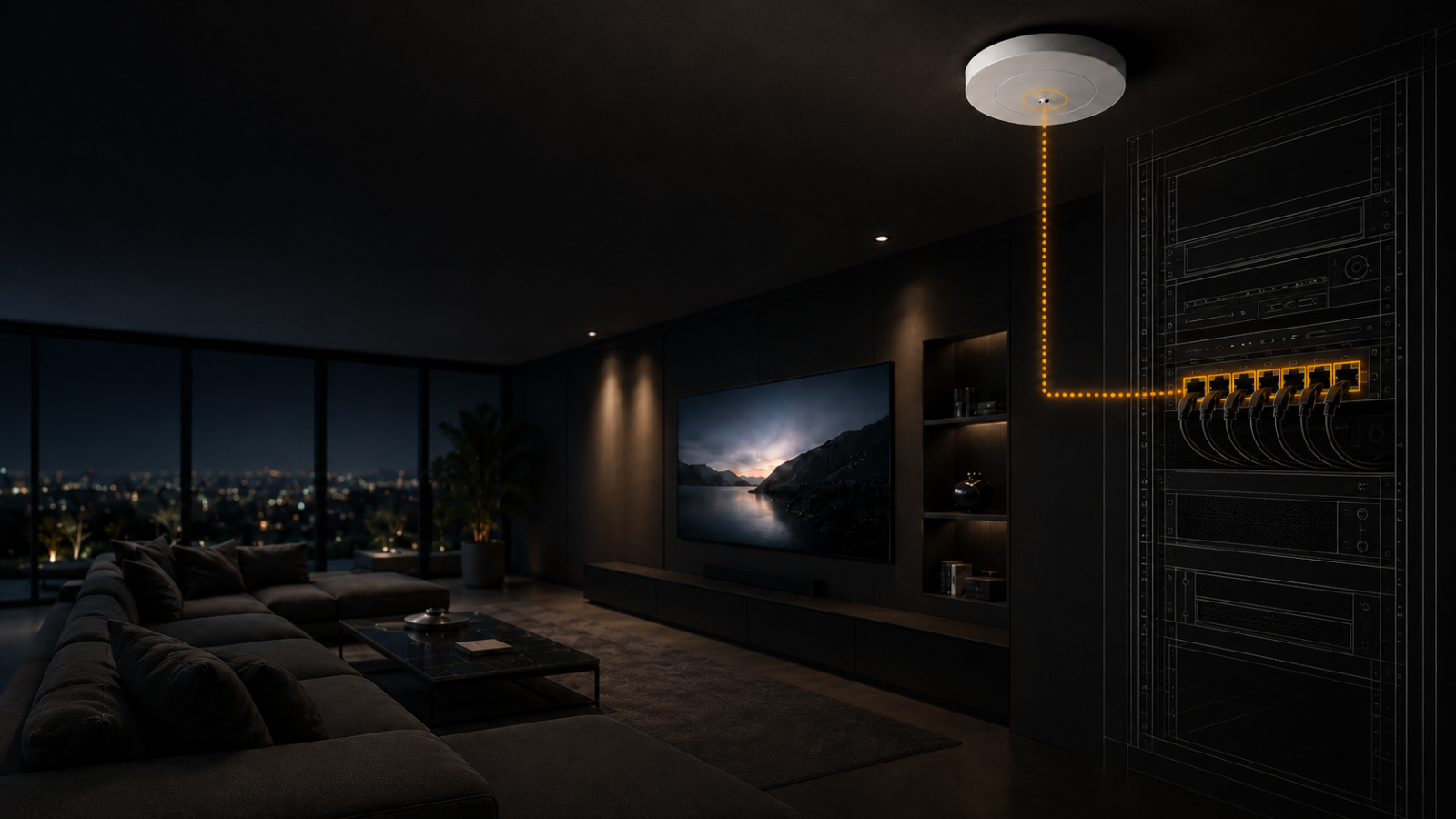

Today’s homeowners expect seamless connectivity everywhere – streaming on the patio, taking video calls from a home office, or managing lighting, security, and entertainment from a smart app. As Wi-Fi 7 enters the market, faster speeds, lower latency, and greater device capacity are raising expectations for whole-home connectivity even further.
But there’s an important reality that’s often overlooked: seamless Wi-Fi performance depends on far more than the quality of a home’s wireless access points. It is the underlying cabling infrastructure – planned and installed much earlier in the design and construction process – that ultimately determines how effectively those access points can deliver coverage, speed, and reliability throughout the home.
As Wi-Fi 7 enables higher throughput and supports more simultaneous traffic, it’s imperative that the foundational wiring be planned for and installed long before the walls of a home go up. Only then can technology professionals work alongside architects, designers, and builders to ensure that access point locations are coordinated with reflected ceiling plans, equipment spaces are allocated discreetly, and cabling pathways are incorporated into the construction process rather than added as an afterthought when things become complicated and costly.
Early coordination becomes even more important as homes expand beyond the traditional footprint. Detached guest houses, outdoor entertainment areas, wellness spaces, home offices, and pool houses increasingly rely on the same connected ecosystem, placing greater demands on the network infrastructure that supports them.
Therefore, the quality of that infrastructure is important. While access points, switches, and connected devices will inevitably be upgraded over time, the cabling installed during construction may remain in place for decades. That’s why specifying performance-rated cabling such as Cat6A, selecting products from reputable manufacturers, and verifying compliance through independent testing and certification can be so important. Investing in the right foundation from the outset helps ensure the network is ready for both current and future technologies while reducing the likelihood of costly and disruptive upgrades later.
Of course, not every project begins with a blank slate. In renovation projects, existing network infrastructure may not be capable of supporting the full performance potential of Wi-Fi 7. In these situations, technology professionals have an opportunity to educate homeowners about the relationship between wireless performance and the wired network behind it, helping them understand where targeted infrastructure upgrades may be needed. Having these conversations early in the design and planning process helps align expectations, avoid surprises, and ensure investments in new technology deliver the experience homeowners expect.
Power is another consideration, as many Wi-Fi 7 access points require more Power over Ethernet (PoE) than previous generations. If equipment rooms, switch locations, and power requirements aren’t accounted for during design, performance limitations can be unintentionally built into the project before the homeowner even moves in.
The good news is that none of these decisions need to be complicated. They simply need to happen early. Bringing technology professionals into the design-build process from the outset allows project teams to coordinate infrastructure, aesthetics, and performance before constraints emerge. The result is fewer compromises, cleaner installations, and a home that is prepared for both current and future technologies.
For the design-build community, that’s the real lesson of Wi-Fi 7. It’s not just another technology upgrade. It’s a reminder that the best connected-home experiences are created when technology, architecture, and construction are considered together from the start.
When that happens, homeowners get something everyone wants: a home that performs beautifully behind the scenes while looking exactly the way it was intended to.
For a deeper technical breakdown of Wi-Fi 7 infrastructure design, including cable selection, PoE considerations and performance trade-offs, Kordz provides a detailed guide to designing network infrastructure for modern AV environments.
