


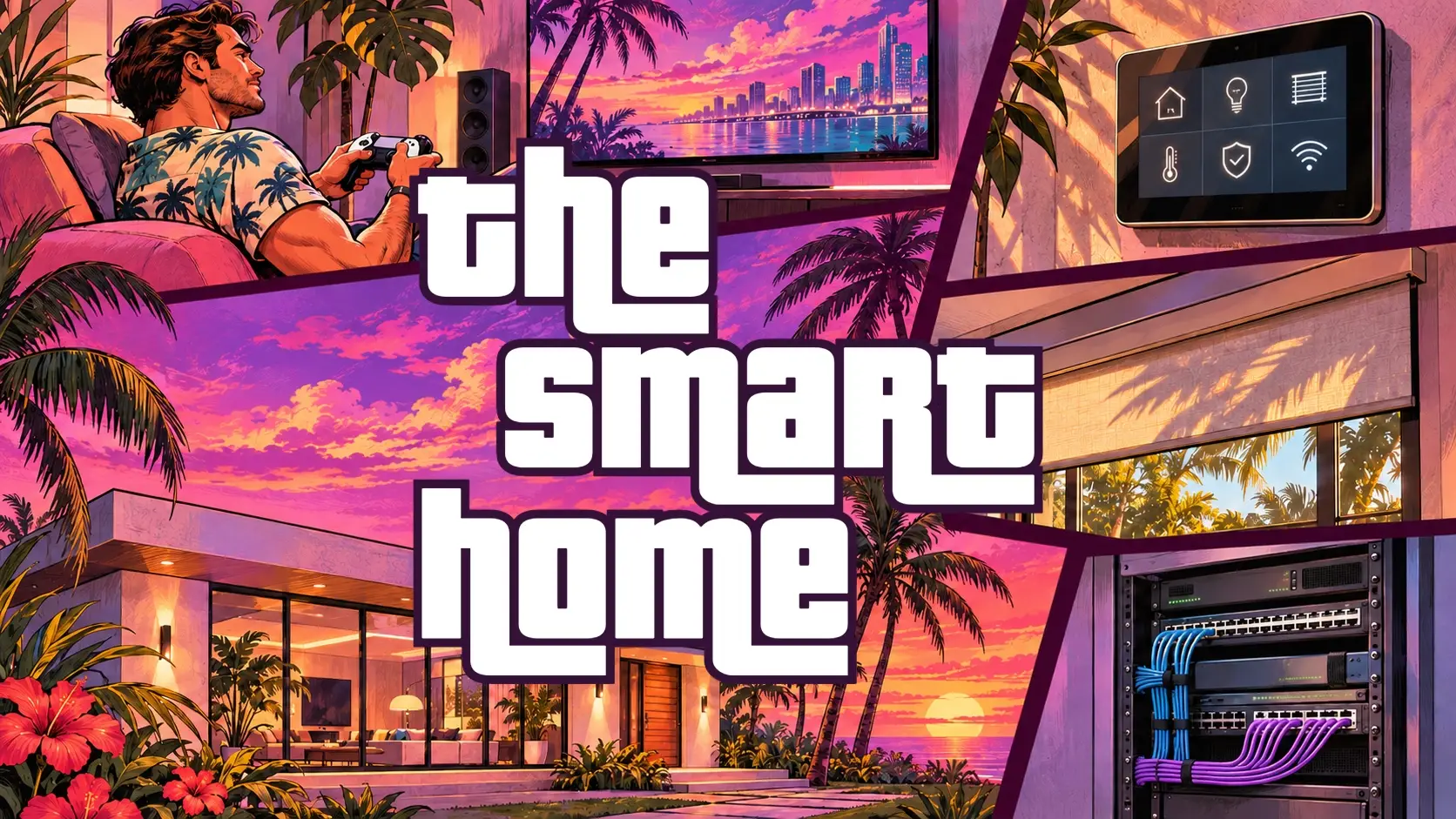

When Grand Theft Auto V came out in September 2013, Xbox 360 players installed it from one disc and played it from another. On November 19, 2026, Grand Theft Auto VI arrives with a digital preload that can require up to 212 GB of free space, depending on the console. Thirteen years later, getting ready to play can mean clearing storage and starting the download days before launch.
A console is still one source in a larger system, but the work around it has expanded. The equipment between the console and the screen can affect how the game feels. The network has to serve the rest of the house while someone plays. And well beyond the media room, the integrator may be working with a client’s existing smart devices, coordinating fixtures and shades with a designer, and planning how the system will be serviced after move-in.
Some of the kids who took turns on the family TV playing GTA III, IV, or V back in the day are likely firing up GTA VI in places of their own, from rented apartments to homes they’ve bought. This time, they get to decide where the screen goes, how the console connects, and what else the room needs to do.
Here are six ways those decisions, and the work behind them, have changed in the 13 years between Grand Theft Auto releases.
1. Gaming changed what goes into the media room
A family that uses the same room for movies and games asks different things of the same equipment. For a gamer, the delay between pressing a button and seeing the result can matter as much as the picture quality. Across this console generation, HDMI features such as variable refresh rate and support for 4K at 120 Hz have made the path between the source and display worth a closer look.
That can change a design decision before the equipment order goes in. If the console lives in a rack down the hall, the switch, receiver, and cable or extender all have to pass the features the client expects to use. A direct connection to the display may make more sense in some rooms, with audio routed back to the sound system. At commissioning, it’s worth picking up the controller and testing the setup from the couch, where the client will actually use it.
2. The network became a system in its own right
A 200+ GB download makes network speed easy to talk about. Cloud gaming and Remote Play support in GTA VI put a different demand on the network. Once someone is playing over a connection, a brief interruption can be felt in the middle of a gaming session.
The decision for gaming companies to lean into this digital download way of delivering media is worthy of it’s own write up, but with streaming clearly the chosen model of major gaming platforms and movie and TV studios alike, it means more stress on those home networks.
For integrators, that distinction shows up on the floor plan. A wired connection to a fixed console or media rack can make sense even in a home with excellent Wi-Fi. Access point locations matter when the client wants to pick up the same game in a room upstairs. Those decisions sit alongside plans for video calls, cameras, and streaming, all of which may be competing for the same connection. It’s easier to make room for cabling and access points before the walls close and the ceiling details are set.
3. Homeowners started bringing their own smart home to the project
When Apple introduced HomeKit with iOS 8 in 2014, it described using Siri to turn on lights and adjust the thermostat with a single command (we’re still waiting…). In the years since, a doorbell, thermostat, or smart speaker has become an entry point to home automation that a homeowner can set up before an integrator ever visits.
That changes the first client conversation. A family may want to keep the doorbell alerts they already share or the voice routine a child uses to turn on a bedroom light. In a remodel, asking which devices are in use, who owns the accounts, and which routines the household relies on can reveal as much as asking what’s on the wish list. It also helps define what the dealer will be expected to support.
4. Cross-brand compatibility gained a common standard
The release of Matter 1.0 in 2022 gave manufacturers a shared way to make supported devices work across different smart home platforms. A compatible shade, for instance, can expose basic controls to more than one ecosystem.
The details become important when that shade is part of a room-wide scene. Basic open and close commands may be enough for one project, while another needs a particular preset or relies on features exposed through a manufacturer’s app or a dedicated driver. When a client wants to bring a device into the system, the useful test is whether it does what they expect from the interface they’ll use every day.
5. Lighting control grew into lighting design
Lutron’s 2018 acquisition of Ketra marked a widening of the integration conversation around lighting. A lighting scene can set brightness and color temperature while also adjusting the shades. In a west-facing living room, that gives the design team a way to manage glare in the afternoon and shift to warmer electric light after sunset.
The result depends on decisions made well before programming. Fixture placement affects where light lands. Fabrics affect how much daylight comes through. Pocket details determine how the shades fit into the architecture. When the integrator, lighting designer, and interiors team work through those choices together, the scene the homeowner selects at the keypad can reflect what the team intended for the room.
6. The handoff became the start of a service relationship
Remote monitoring gives dealers a chance to see when a device drops offline and, in some cases, restore it without needing to roll a truck and send a technician to the client’s house. Integrators can package that work, along with preventive maintenance and defined response times, into a recurring service plan.
That changes what a finished project looks like. The homeowner needs to know whom to call, which equipment the dealer can see remotely, and what happens if the problem turns out to be with the internet provider or a device the family bought on its own. When the picture goes black on the next launch night, that agreement is as much a part of the experience as the screen and speakers.
GTA VI launch day looks a lot different than 13 years ago. One person can disappear into the game while someone else finishes a video call upstairs, and then when 5 o’clock hits the shades can close themselves for the evening. That’s a good test of a modern connected home. Everyone gets to go about their night without having to think about the systems that make it possible. And, at this recent rate of launch, who knows what kinds of crazy advancements we’ll see when GTA VII hits shelves around 2040…
