


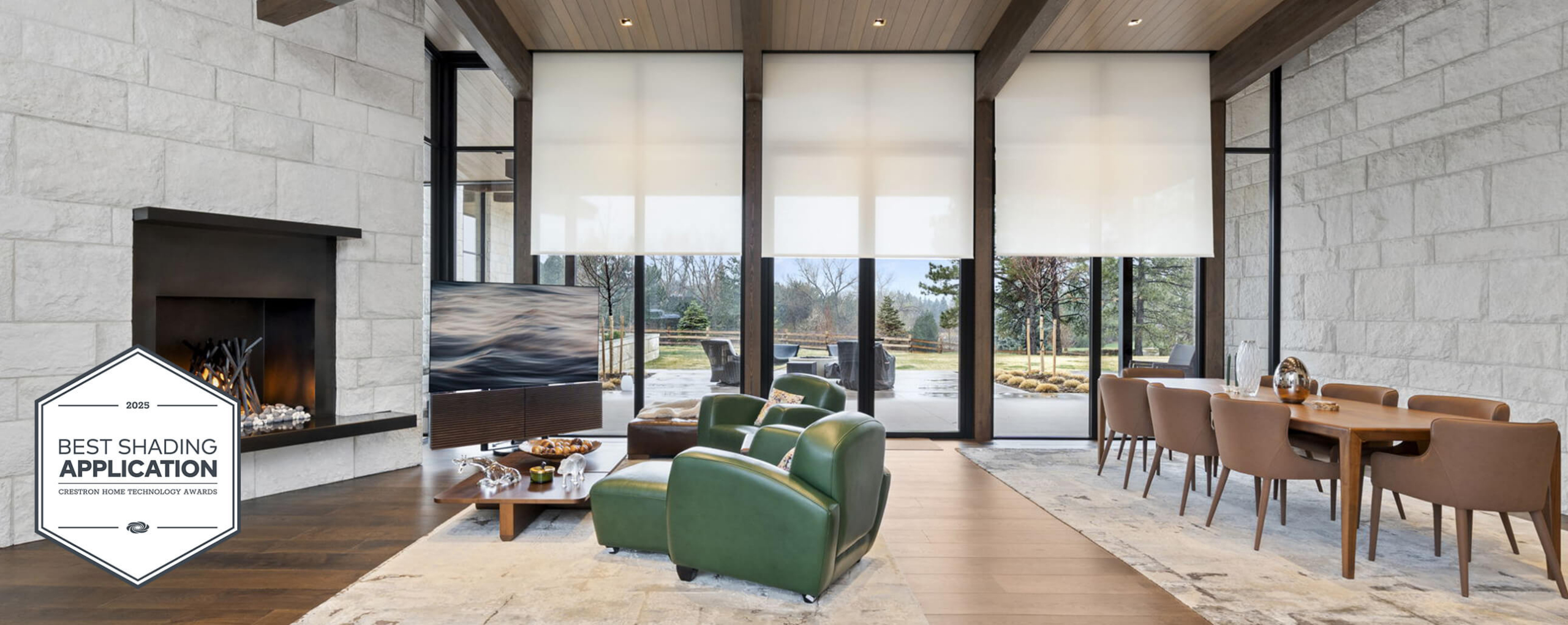
The CEO of Quality Audio Video (QAV), Tyson Rabani, is a fan of Crestron technology — and more specifically, the Crestron Home® OS. After QAV picked up the 2025 Crestron Home Technology Award for Best Shading application, he was interviewed for a recent issue of Crestron Smarter Spaces magazine. He spoke at length as to why Crestron Home OS was his go-to system for this Colorado home, as well as every other residential project his team takes on:
One hundred percent of QAV’s luxury residential, commercial, and hospitality automation is Crestron. Approximately 95% of our deployments operate within the Crestron Home OS environment, with the remainder running Crestron custom for clients requiring bespoke user interfaces.
What we love about the Crestron Home OS specifically is the combination of reliability and flexibility. These are not qualities that typically coexist at this level, but Crestron has achieved them. We have nearly 20 years of systems in the field running on Crestron infrastructure; systems that were there for a client’s dinner party on a Tuesday, for their daughter’s wedding reception, or for a board meeting on a Monday morning. Systems that didn’t fail, didn’t require babysitting, didn’t demand attention. They simply performed.
That track record is the most powerful endorsement we can offer any prospective client. Two decades of people living beautifully with technology that honors the life happening around it.
Reliable Automation
Rabani’s not alone. Phil Roberts, owner of Phil’s Phancy Programming, relies on Crestron as the backbone of his award-winning projects, too. We dug into the need for a robust system when we profiled Roberts’ 2023 Crestron Home Technology Award for Best Lighting Application, a massive, glittering Florida residence built for entertaining:
What Roberts and his team needed to accomplish for their client was a home whose technology functions are almost all completely automated. It’s the best way to manage a home of this size. Whether it’s lighting settings that react to the time of day or a one-button push that flips the house instantly (and reliably) into “party mode,” the platform had to handle complex tasks on the back end while presenting any user with a control system with much less complexity than the average TV remote. The team at Phil’s Phancy Programming needed an end-to-end home automation system with unparalleled power and flexibility — and that’s why they chose Crestron. “Crestron has proven to work the best, be the easiest to use, and provide support with the least number of issues,” says Roberts. “It was a no-brainer to add Crestron solutions to this beautiful home.”
Homeowner Sylvie Acovski agrees: “I love this system. Everything’s programmed to make my everyday life so much easier.”
Roberts and Rabani are just two of the hundreds of dealers who’ve come to rely on Crestron technology to help them create the perfect connected homes for their clients. And they’re also part of a feedback loop that’s key to Crestron’s success: The evolution of Crestron solutions is informed by what our dealer network (and through them, their clients) tells us every day.

Reliability and Durability
Another part of the reason for that dealer loyalty is the durability and reliability of every Crestron solution. Hardware and software products are put through an incredibly tough testing regimen before they’re released. It’s an aspect of the business we’ve covered in depth, both on the Crestron Smarter Spaces podcast in an episode with Crestron’s Christopher Angello, VP of quality, and on the Crestron blog:
One of the aspects of Crestron products that make them truly unique is their ability to withstand all manner of abuse, which means they’ve got to be tested. Before a product is ready for prime time, it gets baked. It gets frozen. It gets battered. It gets probed. It gets bugged and hacked. It gets put through the wringer in Crestron’s in-house electromagnetic chamber. Each machine, from hardware to firmware to software, is rigorously tested so that it’s one less thing you (and your clients) have to worry about.
The Right Interface
In addition to that history of reliability, Crestron’s also uniquely focused on the user experience. The Crestron Home® OS is constantly updated (at no charge to the homeowner) with new features and skills that reflect both the advancing technological landscape and the evolving demands of the market. And at every step, Crestron is taking great care to ensure it’s all controlled with the most intuitive interface possible. To help us understand the complex processes behind that result, we spoke with one of the lead developers of the platform on the Crestron blog:
Jason Oster, a product manager for the Crestron Home platform, has been studying the way people interact with technology for decades.
“There’s an absolute Step One when it comes to creating an effective, intuitive UI, according to Oster. “First you need to clearly define the problem,” he says. “I think people just jump right in and start drawing pretty buttons. Stop — sit down and define what you’re trying to solve.” Are you building a media platform to attract more users and engagement? Or are you trying to make a home automation control that the user can understand instantly?
If the latter’s your goal, understanding just who’s using the interface is the next step. Oster explains: “If you put on the hat of the end user, and then you put on the hat of the dealer, and then you put on the hat of a guest user of the house, then you begin to see the issues that you may be facing.”
All the factors we’ve noted above, from product testing to dealer-driven updates, result in furthering the company’s residential mission: Creating the best possible smart home experience we can achieve, all while the technology fades into the background.
