


Apple has officially made its smart home move, and while much of the attention is going to be rightfully given to the new products announced, there’s another aspect of this launch that should be viewed equally as important: the face that Apple is treating the smart home as a designed system.
With Apple Home Collection and Apple HomeView, announced October 13, the company is no longer sitting adjacent to the smart home category with HomePod, Apple TV, the Home app, and a long list of Works with Apple Home devices. It’s now putting its own brand weight, design language, privacy position, and hardware ecosystem behind a more complete home experience. And they’re doing so with a collection of devices that pack a serious punch on the performance side, as well as on the wallet. This isn’t just a “dip the toes in” kind of moment for Apple. They’ve effectively pushed their smart home chips all in here.
That shift matters for the broader smart home market. And it should matter to custom integrators, designers, architects, and builders who spend their days trying to make technology feel like it belongs in the home rather than simply sitting on top of it.
Apple Is Selling Confidence, Not Just Devices
Apple Home Collection includes smart cameras, thermostats, temperature sensors, a video doorbell, and a smart deadbolt lock developed in collaboration with LG Electronics and Schneider Electric. Apple HomeView is a 7-inch display and speaker device designed to serve as a shared household screen for entertainment, communication, and home control.
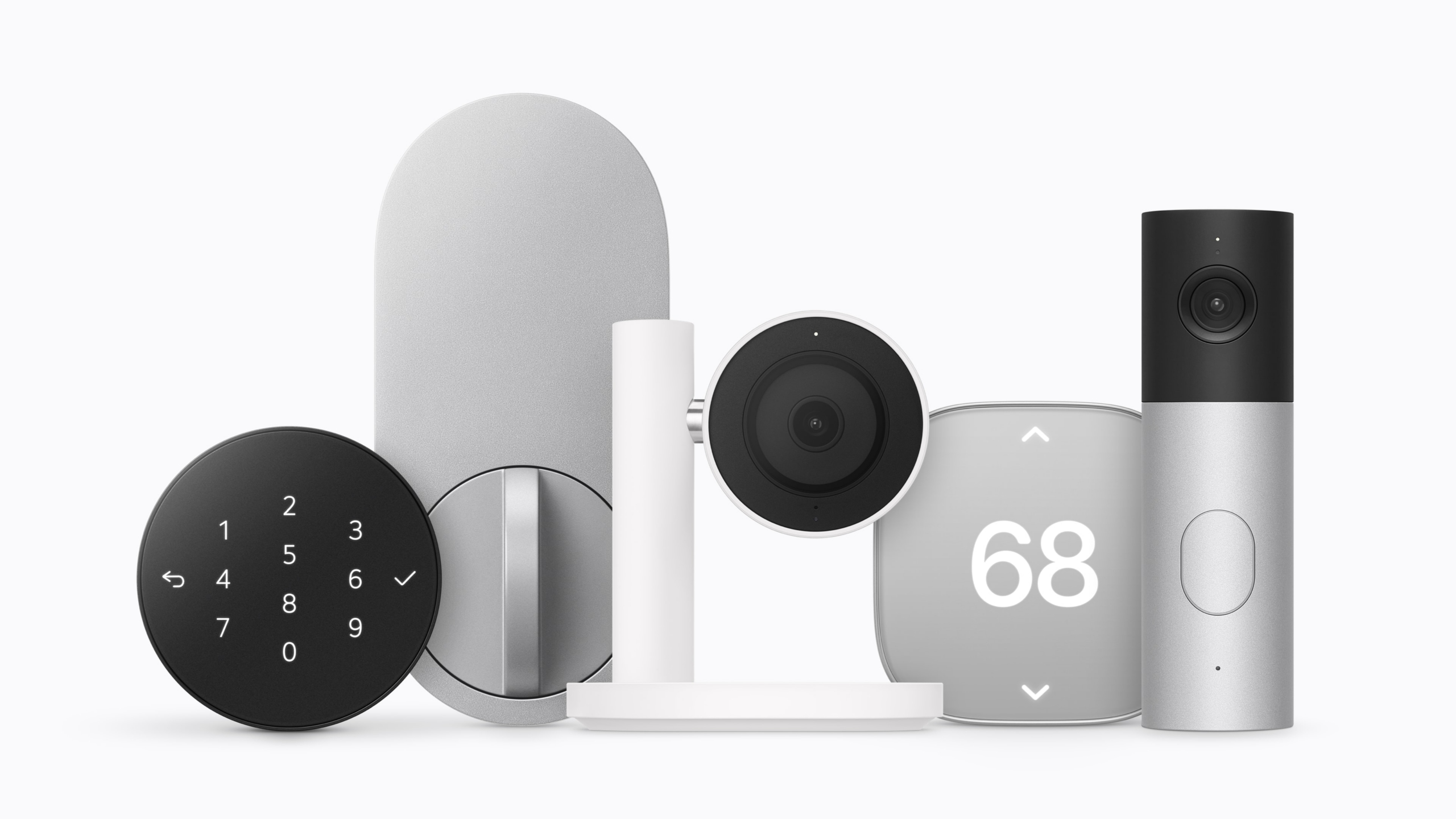
There are product details worth noting. LG’s camera lineup includes indoor, outdoor, floodlight, and video doorbell models, all of the wired variety (no battery-powered models to speak of at launch). The smart deadbolt uses Ultra Wideband so a compatible iPhone or Apple Watch can unlock the door as the user approaches. The thermostats from LG and Schneider Electric use Adaptive Temperature in the Home app, along with room sensors, to manage comfort across the day. HomeView can be placed on a tabletop or mounted to a wall, with a Power Mount PoE Wired option coming in early 2027.
But the product list is not the real story. The real story is how Apple is trying to remove the usual consumer hesitation around the smart home.
The accessories set up with one tap using iPhone. They live in the Home app. They don’t require separate manufacturer apps or accounts. They are end-to-end encrypted in Apple Home. They support Matter, and the lineup uses Thread. Apple also says the products can automatically update network credentials if the home’s Wi-Fi changes.
That is classic Apple positioning: reduce the visible complexity, own the experience layer, and make the customer feel safe choosing the thing.
For the custom integration channel, this should sound familiar. A strong integrator is not simply selling hardware either. The best firms are selling confidence: a home that works, support that remains available, and technology that does not force the client to become a systems administrator.
The Partner Strategy Is the Signal
The partnership choices are particularly interesting here. Apple did not appear to be trying to become a thermostat engineering company, a door hardware company, or a security camera specialist overnight. Instead, it worked with LG Electronics and Schneider Electric to create products that feel native to Apple Home while leaning on companies with their own category expertise.
That is the right lesson to pull from the announcement.

Luxury smart homes work best when the right experts are brought into the project early enough to shape the finished experience. Designers understand how a space should look and feel. Architects understand structure, flow, and proportion. Builders understand what can actually be executed cleanly. Integrators understand infrastructure, control, networking, audio, lighting, shading, security, and the long-term support burden.
When those disciplines work in sequence, the technology often has to fight for its place. When they work in collaboration, the home can feel intentional.
Apple’s launch is not a direct analogue to a custom residential project, but it points to the same principle. The more sophisticated the home experience becomes, the less any one party can create it alone. The smart home is increasingly a coordinated design problem, not merely a product category.
That is especially relevant because Apple is positioning these products not as isolated gadgets, but as pieces of a larger home experience. The doorbell and lock operate together in the Home app. Cameras, thermostats, sensors, HomePod, Apple TV, and HomeView all sit inside the same control environment. HomeView can livestream up to nine camera feeds at once, present favorite accessories through a Home Modular face, and use Siri AI for voice control.
That is a system story. Integrators should recognize the shape of it.
A New Front Door Into the Category
Ahead of the official launch of these products, I argued that Apple’s move into the smart home should be read as validation. Now that the products are official, I think that argument only gets stronger.
Apple is not the first company to make (or at least partner on) a smart doorbell, smart lock, thermostat, camera, or home dashboard. The smart home market already has strong DIY brands, professional control platforms, luxury lighting and shading systems, established security providers, and a deep custom installation channel.
But Apple entering this deeply and this visibly changes the awareness curve.
An Apple customer who may never have asked an integrator about lighting control, whole-home networking, camera placement, access control, or environmental automation may now start thinking about those categories because Apple has made them feel approachable. That does not mean the customer is suddenly ready for a fully integrated luxury system. It does mean the customer’s mental model of the home may begin to change.
That is where the opportunity sits.
Some homeowners will buy Apple Home Collection products, set them up themselves, and be perfectly happy. Some will use Apple’s new third-party installation option through ADT. Some will hit the limits of what a DIY system can do when they want more rooms, better network performance, cleaner device placement, or more advanced automation.
The integrator’s job is not to treat Apple as an enemy at the low end of the market. It is to understand that Apple may become one of the most effective awareness engines the category has had.
Where Integrators Still Matter
Apple is very good at simplifying the front end of a technology experience. That does not make the underlying home any less complex.
The more connected products enter a residence, the more important the network becomes. The more cameras and displays a homeowner expects to use, the more important coverage, bandwidth, placement, power, and privacy conversations become. The more automation leans on occupancy, access, climate, and daily routines, the more important it becomes to design the system around the way the household actually lives.
That is where integrators still have an advantage.
A professionally designed smart home is not just a collection of compatible products. It is a plan. It accounts for wiring, rack location, access points, keypad locations, lighting scenes, shade pockets, speaker placement, control hierarchy, security zones, client preferences, guest behavior, service expectations, and the realities of the architecture.
Apple can make the smart home feel easier to enter. Integrators can make it feel complete.
That distinction matters because Apple’s positioning may also raise client expectations. If HomeView makes a homeowner comfortable with a persistent control screen in the kitchen or hallway, that homeowner may begin to ask why the rest of the home’s interfaces are not equally thoughtful. If Apple’s cameras and locks make access and awareness feel simple, the homeowner may become more sensitive to clunky interfaces elsewhere.
In other words, Apple may not compete with luxury integrators so much as it trains more homeowners to expect better designed technology.
The Design-Build Conversation Gets Easier
There is also a useful opening here for integrators working with designers, architects, and builders.
Apple’s launch puts a familiar consumer brand behind a message the custom channel has been making for years: smart home technology is part of the home’s lived experience. It affects how a space looks, how it sounds, how it responds, how secure it feels, and how easy it is for the people inside to move through their day.
That makes the integrator’s early involvement easier to explain. A designer may not want to talk about network topology in the first meeting. But they will understand why a wall-mounted display, camera sightline, thermostat location, shade pocket, access point, or keypad position should be coordinated before the walls close.
Apple’s collaboration with LG and Schneider Electric gives the channel a clean metaphor: elegant home technology usually requires partnership. The finished product looks simple because the complexity was handled by the right people before the customer ever touched it.
That is also the story integrators should be telling inside high-end residential projects.
A Bigger Category Moment
Apple HomeView is available for preorder now, with availability beginning November 13 in several markets, including the U.S. Apple Home Collection products begin arriving in December, with select accessories available in early 2027.
There will be plenty of time to debate the products themselves once they reach the field. Integrators will want to know how they behave in real homes, how well Thread performs across larger properties, how the camera and iCloud+ requirements fit client expectations, how the ADT installation path works, and how Apple’s approach coexists with professional platforms.
But the strategic meaning is already clear.
Apple has entered the smart home with a message that is bigger than a spec sheet. The home should be easy to control. The products should look like they belong. Privacy should be central. Setup should not feel like a project. The devices should work together. And the smartest experiences will come from collaboration between companies that understand different parts of the home.
For custom integrators, that is not a threat to the luxury smart home. It is an invitation to explain why the professionally designed version of that promise goes even further.
