


David Zohar of Aventura Home Theater (along with his wife and business partner, who owns the firm Sarah Z Designs) has handled some spectacular integration projects in and around Bal Harbour, Florida. One of those projects — featured in our Lighting and Shading issue of Crestron Smarter Spaces magazine — won the 2025 Crestron Home Technology Award for “Best Lighting Application.” The installation consists of two condos that have been joined to create a 7,000-square-foot stunner with wraparound balconies that offer views of the Atlantic Ocean.
Zohar’s client was partial to a certain manufacturer, but the customer soon changed his mind at Zohar’s urging, landing on a Crestron system for lighting (as well as other aspects of the integration). As we noted in the magazine:
Zohar was able to point to some high-visibility solutions nearby that run on Crestron technology. “These solutions have been in the White House for quite a while, so it’s a simple question: ‘If it’s good enough for a president, it’s probably good enough for you, right?’”
In Government and in Court
That’s not hyperbole: Crestron offers a complete ecosystem of certified, robust, and TAA-compliant audio-visual and unified-communications solutions for governments worldwide.
With years of experience, Crestron understands the federal government security requirements for AV and UC technologies. Our advanced control solutions play an important role in helping various federal agencies achieve their security and UC initiatives. Our expertise in these arenas, supported by key certifications and approvals to meet critical government security demands, will help ensure that needs are met and mission requirements are fulfilled every time.
That expertise can also be found in Crestron solutions serving state and local governments, along with courtroom installations. It’s part of a philosophy that extends into every vertical: Make it better than anyone else, and the system can handle anything.
Built for Boats
One way to “build it better” is to design a product for the most demanding environments. A great example: Crestron’s DM NAX® Audio-over-IP technology line was designed to handle conditions at sea. As we noted on the blog:
When Ekin Binal (now director of core technology and strategic partnerships) first joined Crestron, he was tasked with building the company’s next-gen audio platform. “He started reaching out to the people running commercial, residential, hospitality,” recalls Daniel Kerkhof, director of Crestron Marine. “And he also came to me and said, Hey, I hear that you do something with large yachts — what would I need to have as functionalities in my new solution for you to be able to use it on board?” Kerkhof came back with a long list, and Binal began to realize that different subsets of that list would also come in handy for the other verticals.
Binal designed the Crestron DM NAX Audio-over-IP technology solution with marine installations top of mind — and those requirements more than matched the needs of every other application for the DM NAX technology.

In the Air
There’s another example of Crestron’s ability to meet the most stringent requirements for durability and reliability: An airplane that doubles as a hospital. Crestron was responsible for many of the systems aboard the Orbis Flying Eye Hospital®, a fully accredited ophthalmic teaching hospital on board an MD-10 aircraft.
As we illustrated in both the blog post and the accompanying case study on the project:
The Orbis Flying Eye Hospital — a state-of-the-art teaching facility that is complete with an operating room, classroom, and recovery room — allows the Orbis volunteer faculty to travel the world sharing knowledge and developing the skills of local eye care teams.
With Crestron technology, the aircraft’s team can focus on its goal to train eye care professionals in areas with the greatest need.
Unique factors such as weight were a consideration in this project since cutting even a few pounds could result in fuel savings. The compact size and light weight of the Digital Graphics Engines combined with the LED backlighting on the touch screens made Crestron an easy choice.
And Into Space
While Crestron technology is right at home at an altitude of 30,000 feet, it’s also been part of a mission bound for a destination that’s a bit higher: Mars.
In 2020, Crestron was an integral part of the system that brought video back from the red planet via NASA’s Perseverance Rover. As our friends at Altera described on their blog at the time:
Last month, NASA’s Perseverance Rover landed successfully in Jezero Crater on Mars and has taken its first test drive. The Mars 2020 Perseverance Mission Team is the first at NASA Jet Propulsion Laboratory to use a new high-resolution, multi-mission AV collaboration system developed by Amplified Design LLC, which was completed in time for the Mars 2020 Perseverance Rover launch in July 2020.
This AV collaboration system spans 45 new collaboration areas across multiple floors at NASA JPL’s Space Flight Operations Facility in Pasadena, California. The system is based on nearly 200 Crestron DM NVX® AV-over-IP technology streaming media devices that provide secure, real-time AV encoding and decoding for the transport of real-time 4K video streams over standard Gigabit Ethernet. The DM NVX technology backbone distributes video to both the large and small work rooms as well as mission support areas for anywhere-to-anywhere video sharing.
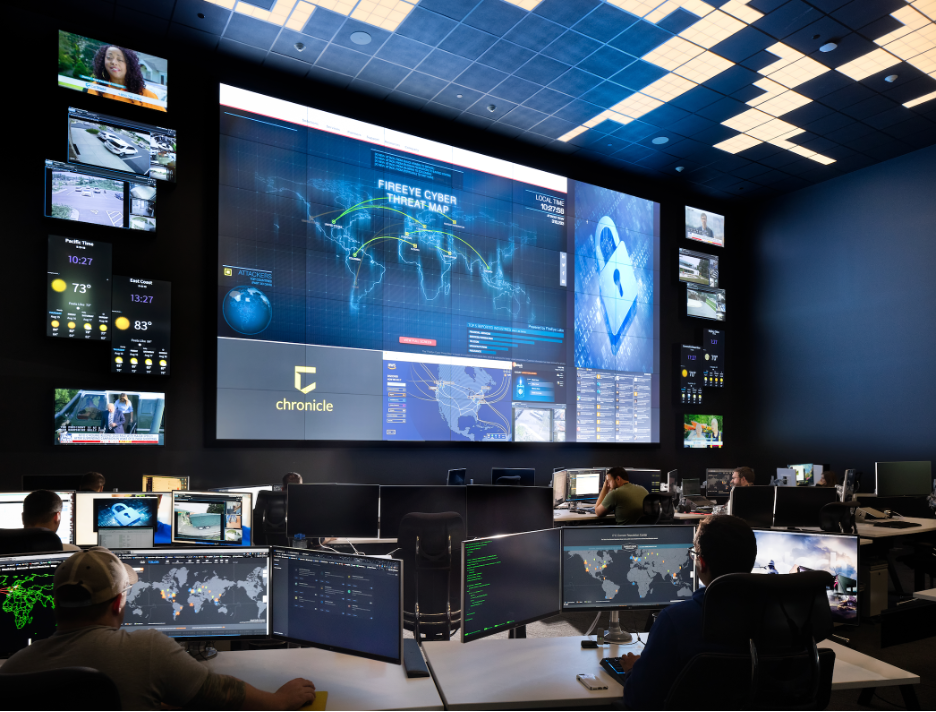
From sportsbooks and command-and-control centers that demand video with incredibly low latency to cutting-edge meeting room solutions that leverage the latest AI, Crestron’s been at the forefront of creating reliable, durable systems that can handle everything from the highest altitudes to the stormiest seas. It’s evidenced by the testing and quality control standards we’re known for; in fact, striving to create “best-in-class” products for every environment has been a guiding philosophy at Crestron for more than 50 years — it’s all part of what we call “True Blue.”
