



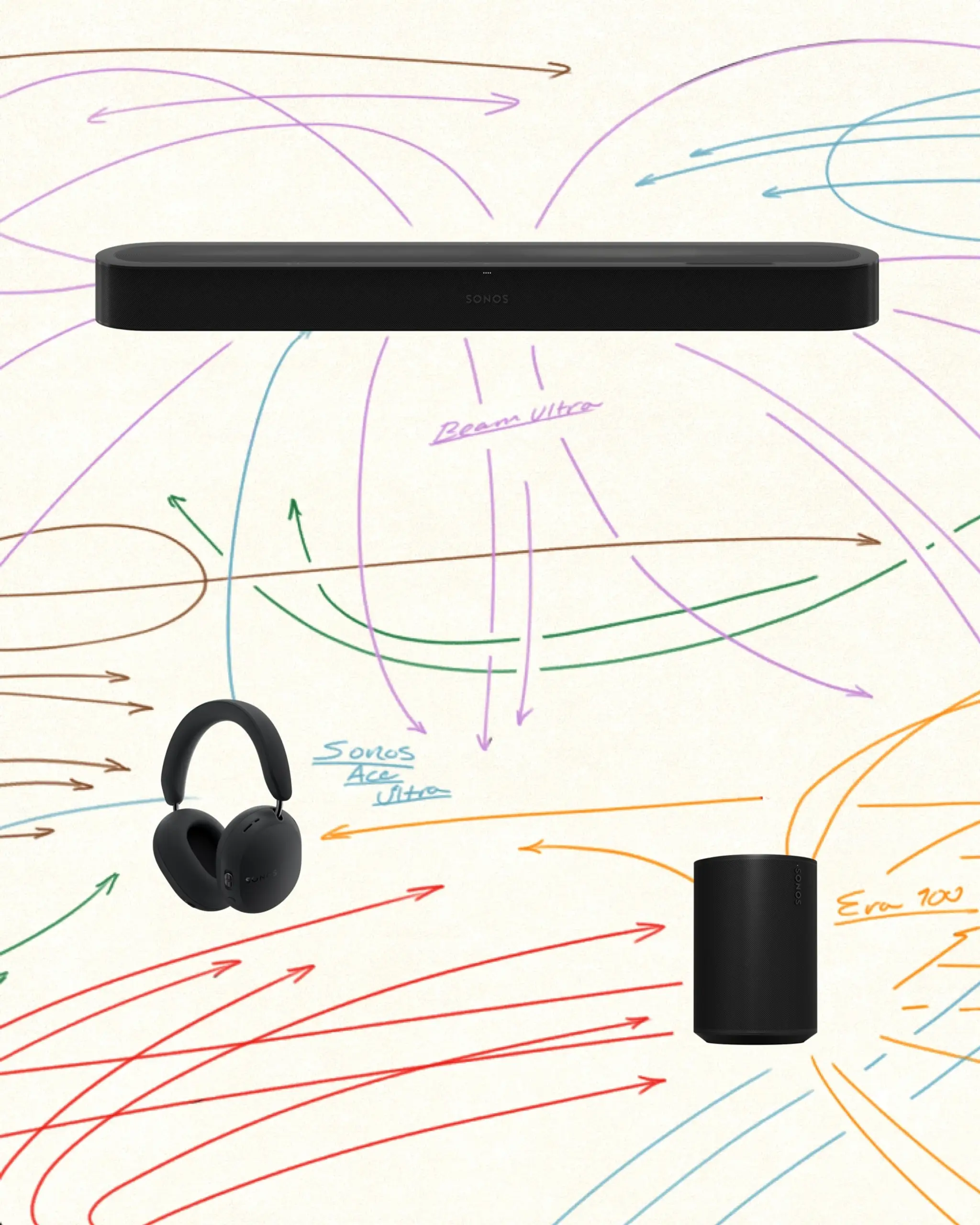
Sonos used CEDIA Expo to introduce new hardware, including Beam Ultra and Sonos Ace Ultra, but the company’s Sonos 27 rollout, which, frankly, didn’t get enough press attention during the show, puts the focus on what happens after products are already in the home.
Sonos 27 is the next generation of the company’s audio operating system, available as a free software update for Sonos S2 products, with feature availability varying by product. The release adds AI control through outside assistants and agents, a forthcoming Sonos-built voice assistant, portable speakers that can automatically become home theater surrounds, headphone linking, and a redesigned app experience. That’s a broad range of updates, but collectively a massive set of new features that really helps wash clean any remaining ill-will consumers (and integrators) may feel from the botched app rollout of a few years ago.
For integrators and connected-home professionals, the update is all about making the Sonos audio system easier to control, easier to adapt, and more useful over time. That is a pivotal narrative in a category where clients today place adaptability above just about anything else when considering a new product (hello, foldable phones).
“Most of the tech industry ships new capability by shipping new hardware, but we built Sonos differently,” Tom Conrad, CEO of Sonos, said in a statement. “Our system grows more capable and smarter over time, so whichever Sonos product you already have at home can do more today than it did last year. That’s exactly what’s rolling out with Sonos 27.”
AI Control Moves Into the Audio System
Sonos 27 introduces Sonos 27mcp, now available in Early Access. Built on the Model Context Protocol (MCP), the feature allows a Sonos system to connect with outside AI platforms, including ChatGPT and Claude. The practical idea is straightforward: if a homeowner is already using an AI assistant, Sonos wants audio control to be available inside that environment.
That open approach is important because home control has often been shaped by the limits of a single assistant or a narrow set of voice commands. Sonos 27mcp points toward a more flexible model, where music and system control can sit inside whatever interface the user prefers. Again. Adaptability.
Den Delimarsky, Lead Maintainer of MCP and Member of Technical Staff at Anthropic, said the Claude integration will allow Sonos customers to control sound directly from Claude “without breaking their flow.”
Sonos is also preparing Sonos 27voice, an AI-powered assistant scheduled to arrive in Early Access later this fall. The company says the assistant is built and fine-tuned in-house to understand music, mood, and control. Rather than relying only on exact artist names or song titles, Sonos 27voice is designed for the way people often ask for music: by memory, feeling, activity, or setting.
That could be useful in real homes, where the request is not always “play this exact track,” but “play something for dinner,” “find the song I was listening to earlier,” or “put on something calmer in the kitchen.” Sonos says the assistant can curate soundtracks for moments such as a morning routine, dinner party, or winding down before bed.
Nick Millington, Chief Innovation Officer at Sonos, framed the direction around choice. “We don’t believe one assistant should own the home. One assistant can’t be great at everything,” he said. “Sonos 27voice is great at music and control, and our open platform lets you bring in whatever’s great at the rest.”
Sonos also previewed Sonos Custom Agents, targeted for 2027, which would allow people to create their own agents through the system, each with its own model, persona, and voice. For the custom installation channel, that direction raises interesting possibilities around more personalized client experiences, especially if homeowners begin expecting control systems to reflect their routines and preferences more directly.
Speakers That Change Roles
Sonos 27 also adds new features to Sonos Fabric, the company’s system intelligence for helping products sense and adapt to one another.
Portable surrounds allow Move 2 or Sonos Play speakers to shift between portable listening and home theater surround duty. Using Sonos Positioning Technology, the speakers can sense their distance from each other and a nearby compatible soundbar through brief high-frequency audio signals, then switch roles automatically. Supported soundbars include Arc Ultra, Arc, Beam Ultra, and Beam Gen 2.
The feature gives integrators and homeowners a different way to think about secondary speakers. A pair of portable speakers no longer needs to be locked into one use case. They can serve a patio, kitchen, or casual listening area, then become part of a theater experience when placed near the soundbar.
That flexibility does not replace a dedicated surround installation for every client, but it gives Sonos a stronger answer for spaces where homeowners want performance without committing speakers permanently to one room layout.
Headphones Join the System
As we previously covered, headphone linking brings Sonos Ace Ultra directly into the Sonos system as an Early Access feature beginning September 29. With one tap, listeners can move audio between out-loud and personal listening, sending sound to the closest speaker or back into the headphones without keeping a phone nearby.
The feature runs on Sonos Headphone Engine 2, the platform built into Sonos Ace Ultra with redesigned Wi-Fi antennas and secure credential storage. Sonos describes the shift as a way for headphones to move through the home as part of the system rather than relying solely on Bluetooth.
For homeowners, the use cases are easy to understand: continue a movie without waking someone, move from a room speaker into private listening, or keep music close while walking through the house. For integrators, the significance is that headphones become another endpoint in the system rather than a separate accessory.
The App Gets a Simpler Structure
Sonos 27app reorganizes navigation around Home, System, and Search across the bottom of the screen. The update adds native swipe gestures, the ability to pin favorite rooms, lock screen and Dynamic Island playback control for iPhone owners, Siri and Shortcuts support, and a refreshed iPad layout.
The app also introduces a virtual volume knob, allowing users to twist two fingers on the screen to adjust volume like turning a dial. Presets, which save a group of speakers, content, and volume for one-tap access, are scheduled to arrive later this fall alongside new system health views.
Those app changes may not sound as dramatic as AI agents or new hardware, but they matter in installed systems because the app is often where client satisfaction is won or lost. If a client cannot quickly find a room, understand system status, or return to a favorite listening setup, the system feels more complicated than it needs to be.
A Platform Story for Installed Audio
Sonos 27 arrives at a time when connected-home clients increasingly expect systems to improve after the original installation. The update gives Sonos a way to talk about long-term system value: products that learn new behaviors, control that can live in multiple AI environments, portable speakers that can change roles, headphones that join the home audio network, and an app that exposes more useful system views.
Beam Ultra and Sonos Ace Ultra give the announcement a hardware anchor, but Sonos 27 gives those products a broader context. It positions the system as something that can keep adapting across rooms, interfaces, and listening modes.
Sonos 27app navigation, portable surrounds, and Sonos 27mcp are available now, with headphone linking arriving alongside Sonos Ace Ultra on September 29. Sonos 27voice is expected later this fall, and Sonos Custom Agents are targeted for 2027. Beam Ultra and Sonos Ace Ultra are available for pre-order, with general availability beginning September 29, 2026.
