



I began my career in this industry in 1987, working on the sales floor at Sound of Music, the company that eventually became Best Buy. Since then, I’ve managed businesses in Honolulu and the Twin Cities and watched our industry evolve dramatically over nearly four decades. Even today, when people meet me, they often assume I’m the “TV guy.” I understand why. Home entertainment has always been a big part of our industry. But at FrontRow Systems, what we do today goes far beyond televisions and entertainment systems.
Our small team, based in Stillwater, Minnesota, works across about 36 different disciplines, including networking, automated shading, architectural lighting, acoustics, climate control, and even air and water quality. My background is in acoustics, but over the years, I’ve come to appreciate how all these technologies work together to influence the way people experience their homes. Ultimately, it’s not about the individual products or systems. It’s about creating a safe and serene living environment that enhances comfort, promotes wellness, and improves everyday life.
Building Healthier Homes
A few years ago, we began working with a local physician, Dr. Nick Alenov, who has spent nearly 25 years helping patients address health concerns associated with environmental conditions. As he expanded his focus toward creating healthier homes, he was looking for a technology partner who could bring the various systems together into one cohesive solution. His approach looks at the entire living environment, from water purification systems that preserve beneficial minerals to advanced air treatment solutions designed to address allergens, airborne contaminants, and mold-related concerns. Mold sensitivity is particularly relevant here in Minnesota. He also pays close attention to building materials and finishes, often recommending natural products such as wool carpeting rather than synthetic materials that can release volatile organic compounds into the home.
Our role is to integrate these different elements into a unified, easy-to-use system. Using Crestron Home as our control platform, we can coordinate HVAC, air treatment, automated shading, and lighting so they work together throughout the day. We can even schedule the home’s wireless network to shut down selected access points near sleeping areas at night while maintaining connectivity elsewhere in the house.
Quiet Counts, Too
Creating a healthy home isn’t just about the quality of the air we breathe or the water we drink. It’s also about the sounds we’re exposed to every day. Traffic, neighboring properties, mechanical equipment, and even activities happening elsewhere in the house can create unwanted noise that affects our comfort and ability to relax. Often, people don’t realize how much these sounds affect them until they’re no longer there. For homeowners in busy neighborhoods or near heavily traveled roads, reducing unwanted noise can make an enormous difference in how peaceful their homes feel.
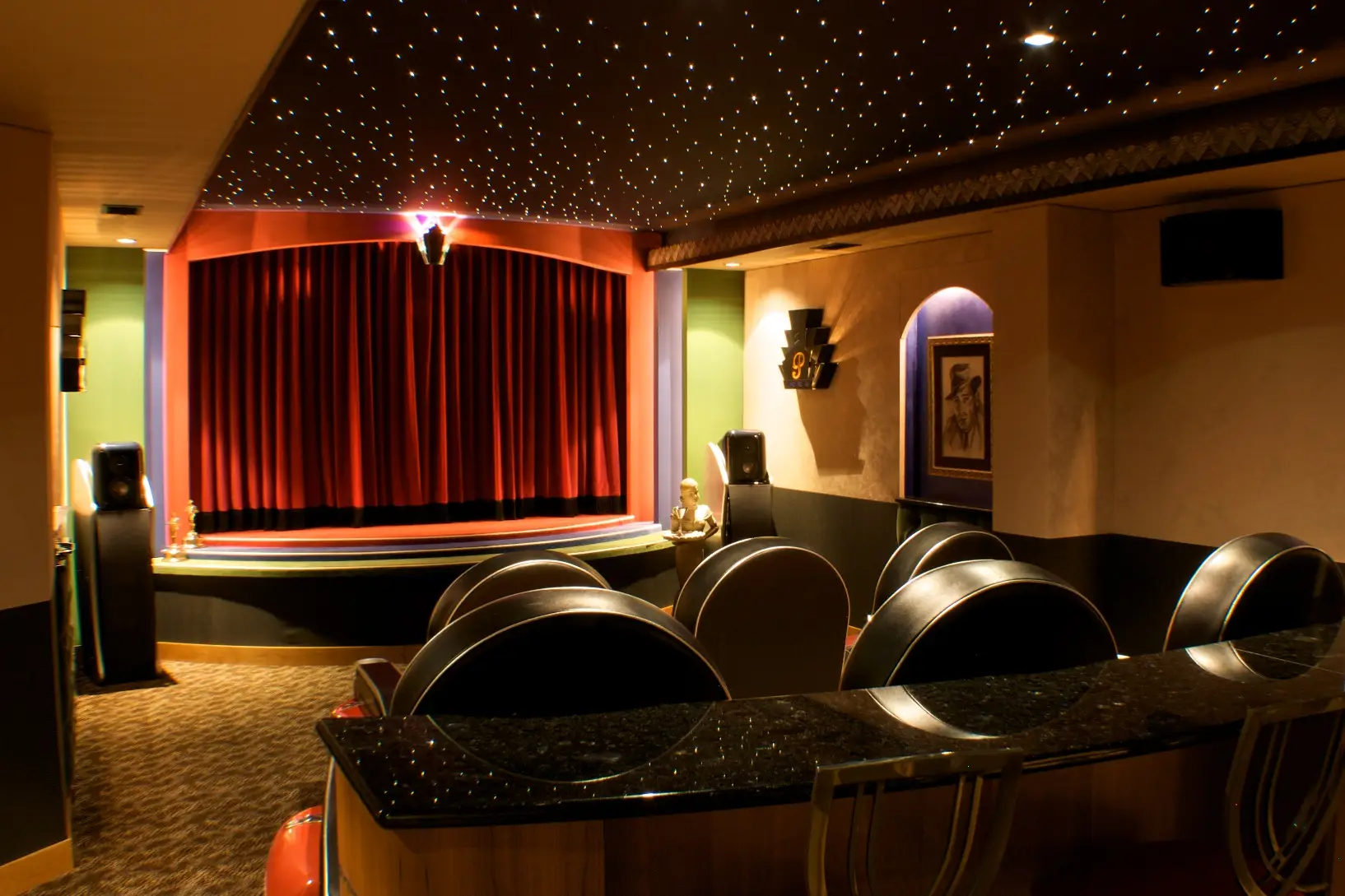
Acoustical design has become an increasingly important part of our work, and many of the builders we partner with now involve us early in the design process. Sometimes the conversation begins with a home theater. Nobody wants to hear children running around upstairs while they’re trying to enjoy a movie. But the same acoustical principles apply to bedrooms, home offices, living spaces, and mechanical rooms. Depending on the application, the solution might be as straightforward as adding mineral wool insulation within a ceiling assembly or as involved as designing specialized sound-isolation systems. The goal is always the same: create spaces that feel comfortable, peaceful, and protected from unwanted noise.
The Most Powerful Tool in the Room
Of all the technologies we integrate into healthier homes, tunable white lighting has become one of the most exciting and impactful. It’s also one of the easiest technologies for homeowners to immediately understand once they experience it. Throughout the day, our bodies respond to changes in natural light. Brighter, cooler light during the morning and daytime helps reinforce alertness and our natural circadian rhythms. As the sun sets, warmer, lower-intensity light helps signal that it’s time to slow down and prepare for sleep. Unfortunately, traditional residential lighting rarely follows that pattern. Most homes have essentially the same color temperature of light whether it’s eight in the morning or ten at night.
With DMF’s tunable white lighting technology integrated into Crestron Home, we can recreate those natural transitions automatically throughout the house. And the homeowner doesn’t have to do anything. The system follows a programmed circadian schedule, day after day, while still allowing complete manual control whenever desired. For clients who are particularly focused on wellness, this is a significant benefit. Light is one of the environmental signals that helps regulate our internal biological clock, and thoughtful lighting design can support healthier sleep-wake patterns.
One of my favorite demonstrations is to take a DMF fixture up to 4,000 Kelvin, creating a very cool, bright white light. I explain that this type of color temperature is commonly associated with task-oriented environments, including medical and surgical spaces. Most people immediately recognize how different that feels from the warm lighting they prefer in their homes. Interestingly, I have a couple of surgeon clients who actually enjoy that cooler light because it’s what they’re accustomed to working under! Then I gradually bring the color temperature back down to a warm, comfortable level, and you can almost feel the entire room relax. That simple demonstration communicates more about the importance of lighting than any specification sheet ever could.
Since partnering with DMF Lighting, our architectural lighting business has grown tremendously, and it continues to expand. We’re currently working on a residence that incorporates 236 two-inch tunable white fixtures and over 1,200 feet of tunable linear lighting, all integrated into a comprehensive Crestron lighting control system. Earlier in my career, I didn’t necessarily walk into every home thinking about how much better the lighting could be. Today, it’s one of the first things I notice.
DMF has become one of the most important tools we have for creating these environments. Their two-inch architectural fixtures virtually disappear into the ceiling, allowing the architecture, finishes, artwork, and furnishings to become the focus rather than the lighting hardware itself. With DMF’s PhaseX technology, we can achieve exceptionally smooth, flicker-free dimming down to 0.1 percent. That level of control makes it possible to provide just enough illumination for someone walking to the kitchen in the middle of the night without flooding the home with bright light.
Another important advantage for our wellness-focused clients is the way the DMF system is designed and wired. PhaseX tunable white fixtures operate using conventional electrical wiring and don’t require individual wireless radios inside each fixture to communicate with the control system. That’s particularly attractive to clients who prefer to minimize unnecessary wireless devices throughout their homes. Many of these homeowners ask us to hardwire as much technology as possible, including networking, control systems, thermostats, and other connected devices. For clients focused on creating a more carefully controlled sleeping environment, that’s an important design consideration.
The Wafer Light Problem
One of the things that continues to surprise me is how often I walk into multimillion-dollar homes and see ceilings filled with inexpensive wafer-style LED lights. You can have a beautifully designed $3 million or $5 million home, with incredible architectural details, custom cabinetry, natural stone, and carefully selected artwork, yet the lighting does very little to complement any of it. With many wafer fixtures, the light source is directly visible, creating glare and harsh illumination. Rather than highlighting the textures and finishes throughout the space, the lighting tends to flatten everything out. Beautiful granite countertops can look completely different under poor-quality lighting, and artwork can lose much of its depth and character.
I often ask builders a simple question: Would you install inexpensive linoleum flooring throughout a custom home at that price? Of course not. Then why would you illuminate that same home with lighting that looks like it belongs in a parking garage?
A big part of our work with builders involves education. We’ll often bring a demonstration kit to a lunch meeting and show them the difference between a properly engineered architectural downlight and a basic wafer fixture. With a quality recessed downlight, the light source sits deeper inside the housing, reducing glare while delivering controlled, beautiful illumination exactly where it’s needed. When builders see the difference firsthand, the conversation changes. The builders who recognize the value of great lighting often become some of our strongest long-term partners because they understand that lighting isn’t simply an electrical requirement. It’s an essential part of the home’s architecture and the way people experience it.
Small, Personal, Accountable
FrontRow has intentionally remained a small, highly specialized company. Over the years, I’ve worked for larger organizations where the person designing and selling a system wasn’t necessarily the person overseeing its installation. Sometimes a carefully developed design would be handed off to a technician who had a completely different interpretation of how things should be done. That disconnect could be frustrating for everyone, especially the homeowner. At FrontRow, we take a much more personal approach. I’m typically the first person a client meets, and I’m often the last person they see when a project is completed. Our lead technician, Connor, who has worked alongside me for about seven years, likes to say that when you choose a technology integrator, you’re essentially getting married. There’s a lot of truth to that. These aren’t relationships that end when the equipment is installed. We’re often involved with our clients and their homes for decades, helping them adapt their systems as technology changes and their families grow.
That’s also why we stand behind our workmanship with a lifetime warranty. Once wiring is installed inside the walls of a home, it should be designed and installed properly so it can remain reliable for years to come. Homeowners sometimes ask why we install so much wiring when nearly everything today is advertised as wireless. My answer is simple: It takes a lot of wire to make wireless work properly.
That commitment to long-term reliability also influences the manufacturers we choose to partner with. One of the reasons we’ve developed such a strong relationship with DMF Lighting is the quality of the people supporting the product. Our local representative, Dan Pasillas, has an exceptional understanding of the technology and is always available when we need assistance. On our current 236-fixture project, DMF’s lighting design team coordinated our architectural lighting with the decorative fixtures specified by the interior designer, bringing everything together into one comprehensive reflected ceiling plan. Our representative was then able to turn that coordinated design into a complete rough-in equipment order in a matter of minutes. That level of support is incredibly valuable, especially on large, complex projects where coordination between the designer, builder, electrician, and technology integrator is essential.
Design for How They Live
When I first meet with homeowners, I tend to ask questions that might seem a little unusual coming from someone in the technology business. How do you typically start your mornings? What does your evening routine look like? How old are your children? How do you imagine your family using this home five or ten years from now? Those conversations tell me far more about what we should design than simply asking how many televisions or speakers someone wants.
For example, a family with a newborn may benefit from extremely soft, low-level lighting during late-night feedings, allowing parents to move comfortably through the house without turning on bright overhead lights. As that family grows, their needs change. Lighting, security, networking, and control systems should be designed with enough flexibility to adapt along with them. The goal isn’t simply to install technology that works beautifully on move-in day. It’s to create a home that continues to work beautifully as life changes.
One family I’ve worked with for 30 years recently completed a new lake home east of the Twin Cities. It’s the fourth or fifth home we’ve designed systems for over the course of our relationship. Despite all those years of working together, they had never incorporated a comprehensive lighting control system into one of their homes. This time, they decided to move forward with it largely because they trusted our recommendation. Initially, the homeowner was somewhat skeptical about whether it was really necessary. Today, when we ask her what her favorite feature of the new home is, her answer is simple. The lighting. For me, that says everything.
Our job isn’t about selling equipment or filling a house with technology. It’s about understanding how people live and creating environments that make their everyday lives more comfortable, enjoyable, and healthy. When thoughtfully designed lighting, shading, climate control, acoustics, and other technologies work together, the home becomes something more than a collection of individual systems. It becomes a place that actively supports the people living in it. And that’s really what we’re trying to accomplish at FrontRow Systems: using technology to make the home a healthier, more comfortable, and more beautiful place to live.
