



Nick Hock had a straightforward question after watching a group of 40 people crowd into a meeting room designed for, at most, 30: Why hadn’t they used the much larger and tech-ready auditorium down the hall?
The answer, he recalled, was that the larger room was too hard to use. Hock’s response was to ask, “Why is it so hard to use?”
Reprogramming helped address the problem, but the experience illustrated a fundamental challenge for adaptable commercial spaces. A room’s capabilities have limited value when the people responsible for it avoid using them.
That distinction ran through Connected Design’s “Designing & Integrating Adaptable Spaces” roundtable, moderated by Editor-in-Chief Rob Stott. Hock, director of installations and integration at Image Engineering, joined Brad Hintze, executive vice president of global customer success and marketing at Crestron, and Josh Barney, CEO of SEAT (Sports Entertainment Alliance in Technology), to examine how technology can support venues beyond their primary events.
Their experiences point toward an operational definition of adaptability: a space should accommodate changing activities in ways its staff can realistically manage.
A Business Beyond the Match
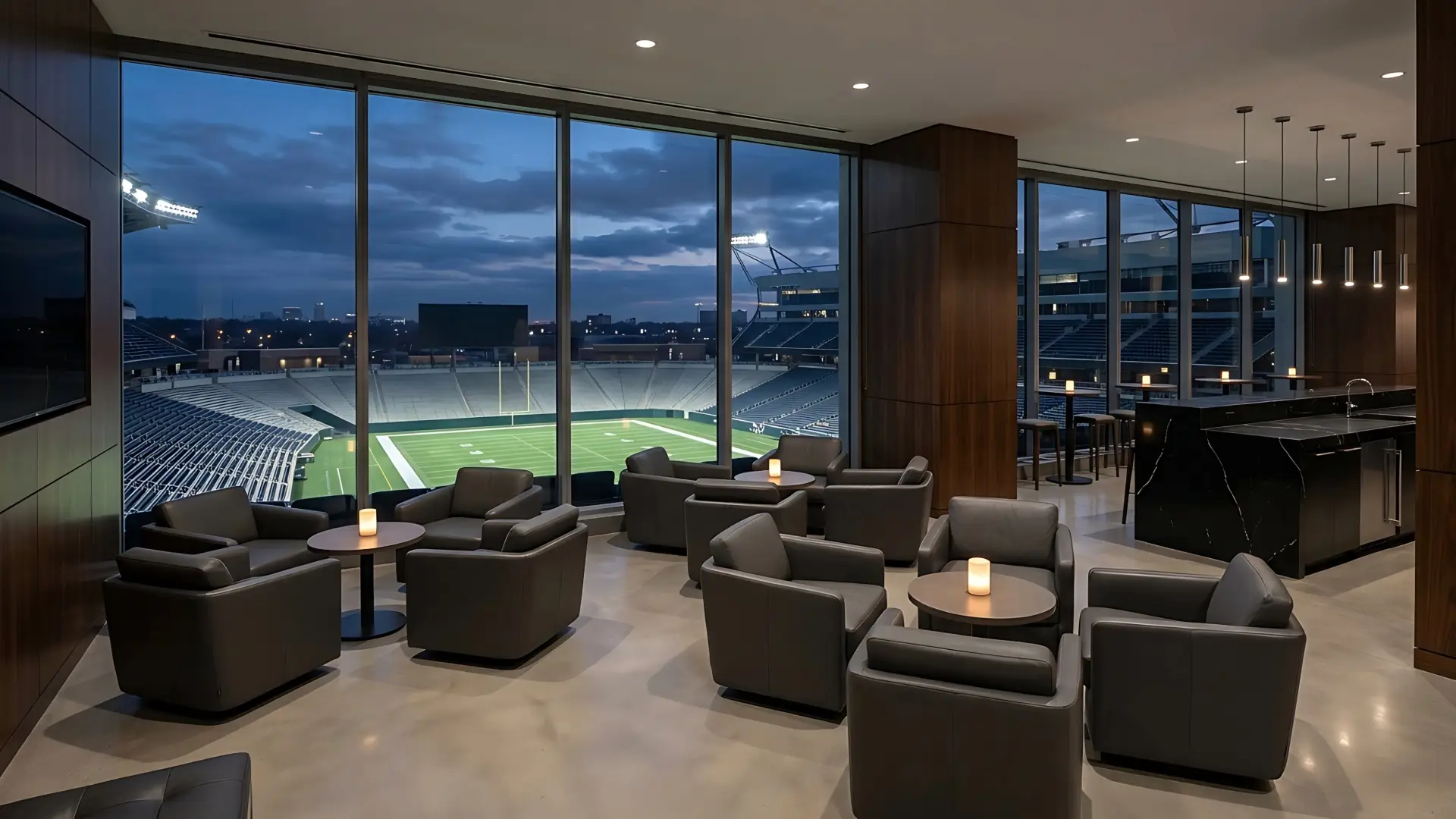
For sports venues, a topic with which the roundtable participants were intimately familiar, year-round use starts with understanding what the building can offer between games. Barney described the opportunity to accommodate concerts and corporate events, each with different expectations for how a club or hospitality space should function.
The goal is to make those transitions manageable without needing to routinely bring in additional AV support. That changes the conversation from specifying equipment for a single event to planning infrastructure that seamlessly supports different experiences.
“Organizations want the flexibility to adapt the space without ripping all of it out,” Hintze said.
He described demand for centrally managed systems that let venues move between event formats without continually expanding their technical teams. Platform selection, in that context, becomes a business decision about what an organization can offer and sustain.
Barney also cautioned against assuming another venue’s successful installation provides a ready-made answer.
“Not every tech stack is the same,” he said.
Learning from peers — something the owners and operators of venues most certainly do, by looking connecting with and observing other venues in their respective leagues or markets — remains valuable. The integrator’s responsibility is to understand how an idea fits the client’s existing systems and intended experience before proposing a similar solution.
Early Collaboration Shapes the Budget
Connected Design’s Industry Pulse research on adaptable commercial spaces identified budget as the leading barrier to more adaptable commercial spaces, selected by 41 percent of respondents. Lack of early collaboration followed at 28 percent. Hintze questioned whether the ordering fully captured how those problems connect.
“There’s always enough options for how to solve a problem and to address what they’re looking for, but only if you get in early,” he said.
His argument was that early involvement preserves room to develop alternative approaches or explain why a budget needs adjustment. Barney added that budgets themselves can miss the mark when the people defining them lack the necessary technology input.
“Budgets don’t truly get built out appropriately if you don’t have the right people talking around what those technology components will be,” Barney said.
The implication for integrators is to make the desired experience clear while design choices remain open. A proposal becomes easier to evaluate when the client understands what a provision enables and what they would give up by removing it.
Hock extended that advice to relationships with architects, who may understand the desired result without knowing everything required from a technology standpoint.
Simple Questions Reveal the Real Requirements
Technical expertise can also lead a team to move ahead of the client’s expectations. Hock described how changes in coaching staff can require different control interfaces even when the installed hardware remains in place. He recalled his own experience following John Harbaugh’s team after he departed the NFL’s Baltimore Ravens franchise and moved a few miles up the road to take over as head coach of the New York Giants. The trust Harbaugh and his staff placed in Hock in Baltimore resulted in them asking for a similar tech set up in New York/New Jersey.
But, of course, there’s the question of what’s going to be possible given the systems and equipment already in place.
Before getting to any of that, though, Hock’s discovery process includes a question that leaves little room for technical assumptions: “When you come into the space, what do you expect the room to do?”
That answer can shape the design more effectively than beginning with a discussion of devices. It gives the integrator a way to understand what an action such as turning on the system means to that particular user.
The research reinforces the importance of that work: 79 percent of respondents called ease of use extremely important when designing adaptable commercial spaces.
The panel also connected expectations inside venues to experiences people already have at home. Hock described suite users expecting control over temperature and background music. Barney recalled questions during his work on the Delta Center renovation, where the Utah Jazz (NBA) and Utah Mammoth (NHL) play, about matching familiar consumer experiences.
For designers and integrators, the lesson is to examine what users consider normal before deciding what they should have to learn.
Support Is Part of the Platform
Adaptability also depends on what happens when a system needs attention. Hock emphasized manufacturer support, particularly when an integrator deploys technology at an unfamiliar scale.
“It may not be the cheapest component, but if they have the service and support, I’m always going to pick that component,” he said.
Barney highlighted employee education as venue technology and its possibilities change. And Hintze urged teams to extend their thinking beyond opening day: “Think beyond just that initial configuration and think about the full five-to-ten-year life cycle of the system.”
Together, those perspectives suggest a broader role for the integrator. The work includes helping clients understand their options, supporting the staff who operate the space, and preserving the ability to respond when needs change.
The crowded meeting room offers a useful test of whether that work succeeds. An adaptable venue should give people the confidence to use the capabilities already available to them, on game day and throughout the rest of the calendar, no matter who’s stepping into that space.
