


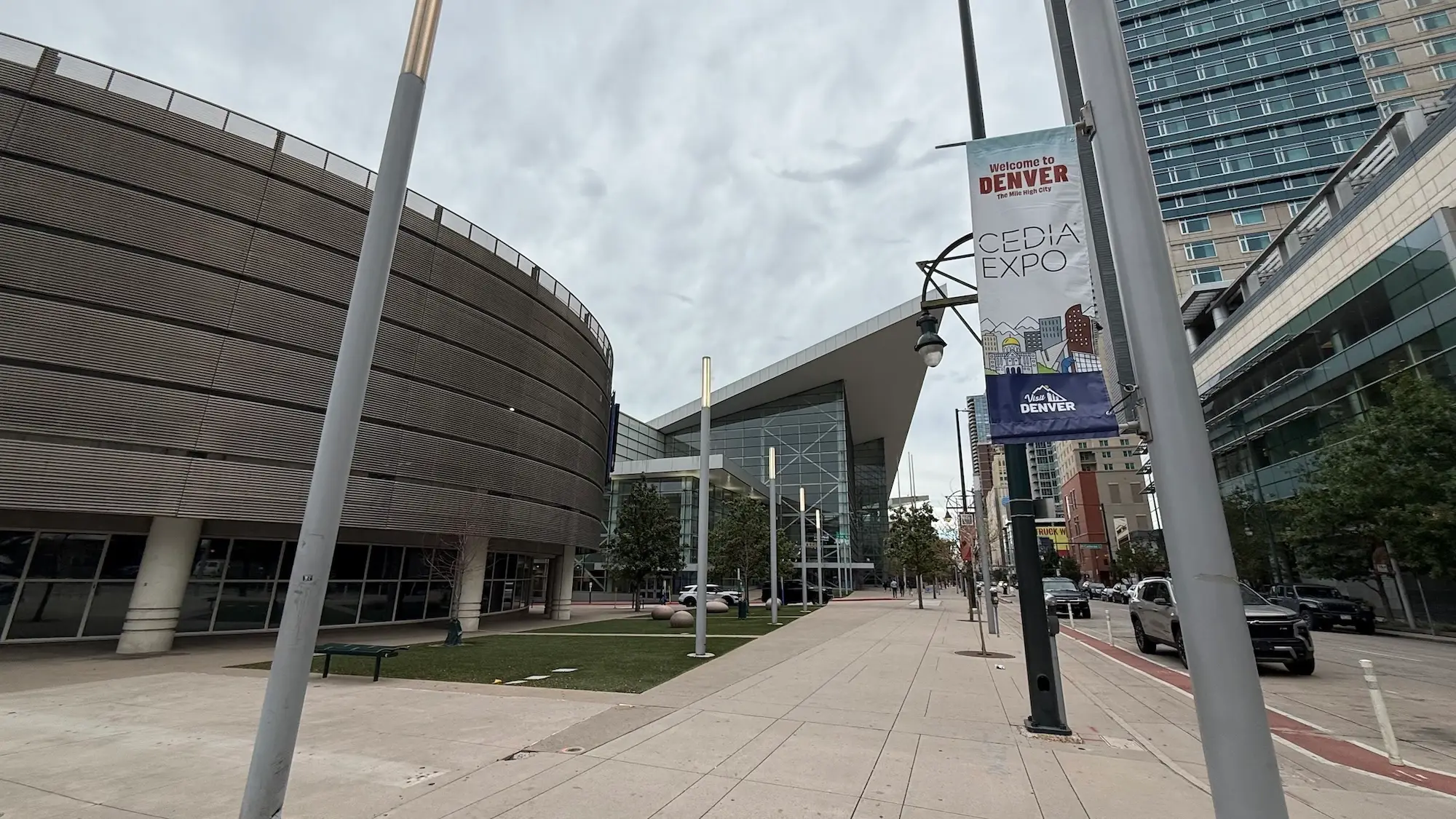

To borrow from a common saying: Don’t judge CEDIA Expo on its latest performance. The recent history of the show is well documented, and the whispers in the hallways of the Colorado Convention Center might as well have been spoken into a microphone on the Smart Stage.
But here’s the thing: Speaking with show organizers and, perhaps, the most important individual as it relates to the show’s future, there is plenty to be excited about when it comes to Las Vegas in 2027 and beyond.
We’ve covered ad nauseam the acquisition of Emerald and Questex by Apollo, but up until this point, we haven’t really been able to dig deeper into what the acquisition means for CEDIA Expo and the broader portfolio of events that these now-combined companies (under the new Forge brand) own and operate.
The timing of all of these announcements over the past few weeks was certainly exciting as CEDIA Expo drew nearer, but it also didn’t really allow for much in the way of a strategy shift or real impact on this year’s show. Which, when you consider all of the noise in the custom integration events space right now, was rather unfortunate.
Understanding that, I made it a point to try to get some time with Paul Miller, the CEO of this new Forge operation (and the aforementioned “most important individual”), to try to get a peek into his thinking around this show and the broader meetings and expositions landscape. And it’s fair to say that I walked away not only impressed but a little more comfortable about where CEDIA Expo is heading.
Our conversation – which you can watch in full on the latest Connected Design Podcast episode – offered an early look at how Forge will look to improve upon an established event like CEDIA Expo not simply by making it an even larger trade show, but by creating a more intentional, data-informed, and customer-driven experience.
CEDIA Expo’s Future Starts With Trust
Miller framed live events against a defining business reality: audiences are sorting through more digital noise, more AI-generated content, and more uncertainty about what to trust.
“In an AI world where there’s a lot of AI slop out there and you don’t know what to trust or not trust, people are going to gravitate toward trusted forums,” he told me. “That could be podcasts, it could be media, but very much it’s going to be real-life events. Starting from the very, very top, this kind of trusted environment of meeting people, shaking hands, and looking them in the eye is actually being benefited by AI, which is a good thing.”
Digital research can help connected home professionals keep up, but CEDIA Expo still gives the industry a place to compare notes, see products in context, and build relationships face to face.
Miller was clear, however, that being in person is no longer enough.
“I don’t think that’s enough in itself,” he said. “I think what that we’ll do is attract marketing attention to the medium. In my opinion, that will attract more chief marketing officers and potentially more budget toward this medium. Now, while that sounds great, at the same time, I think the demands on us are going to get even higher than they have been before. Demands for ROI, demands for reporting and metrics, demands for better experiences at the live event.”
To that end, Miller made it clear that one of his biggest priorities for CEDIA Expo and other events is to help people find the right conversations faster.
“Don’t let me just walk around and bump into people,” Miller said, speaking from the attendee’s perspective. “Help me meet people. I can do the bumping in at the bar. That’s still a good thing. But if you can help me and curate meetings, and that’s where I think it really all comes together. If we’re able to know what you’re interested in through your reading habits and then bring that to the live event and say, ‘Hey, you should probably be meeting these customers, or they should be meeting you,’ I think we end up in a really, really good place of connecting buyers and brands.”
CEDIA Expo already creates discovery through booths, education, manufacturer meetings, and hallway conversations. A stronger layer of curation could make those moments more productive.
Integrators are not all looking for the same thing. Some are evaluating AI and software tools. Others are expanding into lighting, energy, wellness, or outdoor living. Manufacturers, meanwhile, may need to reach very specific dealer profiles. If Forge can use data to improve those connections, CEDIA Expo could become more valuable without losing the energy that makes trade shows work.
ROI Is Becoming a Time Question
Miller repeatedly came back to the idea that event value is now measured less by general attendance energy and more by the specific outcomes customers can take home. That’s theme that should resonate with custom integrators on a very deep level. Time is, to some, more valuable than the dollars actually spent on attending this show. So, how can organizers work to make it worth attending?
“I think the good old days of, ‘Look, it was crowded, and it felt good,’ are going away,” Miller said. “I think it has to be, ‘It’s crowded, and it felt good, yeah. But who did I meet? What sales-qualified leads did we put into our CRM? What marketing-qualified leads did we put into our CRM? How do we report back to our CMO, who probably isn’t here, but I’d like to see here, and say, look, this is what we got out of this event, and we should be going there next year as well?'”
Those are hard questions to answer because attendees and exhibitors exist at various stages and come into an event like CEDIA Expo with very different goals in mind. A mature manufacturer may be trying to meet existing customers, hold NDA product conversations, and reinforce its brand position. A startup may be trying to generate awareness. An integrator may be trying to decide which product categories, service models, or software tools deserve attention.
Underneath those different goals, however, is the same core metric.
“It’s the return on their time,” he said. “Anybody, it doesn’t matter if they’re small or large, they’re committing their teams, they’re committing their people. They’re probably coming to Denver here for three, four, five, six days. That’s a huge time commitment. So, they’ve got to see some return on that.”
Education, Networking, and Product Discovery Are Blending
Miller also pushed back on the idea that all B2B events should follow the same model. Some markets are primarily about writing orders. Others need more education, peer exchange, and market context. He sees CEDIA Expo in the latter camp.
“In tech-enabled industries or tech-disrupted industries where lots is happening very fast in the residential space, and the technology in the home is a radically changing environment, you’ve got lots of things to do when you bring a community together,” Miller said. “Firstly, you’ve got to educate people on what’s happening and how do you deal with it, hopefully by bringing in people who have case studies, who have lived the dream, who have made mistakes. They’re going to share those with you, so you don’t make the same mistakes, or at least they’re going to tell you, ‘This is how we did things well.’ So, education in fast-moving, tech-disrupted industries is really, really key.”
Product discovery remains a major reason to attend CEDIA Expo, but the role of the integrator is expanding. Integrators are being asked to coordinate with design and construction teams, manage software-driven systems, and explain complex technology in experience-driven terms.
“Yes, people want to walk around the show floor and discover new product and technology, say hi to customers, and potential new customers,” Miller said. “They also want to get educated, so you’ve got to have a really good conference program and a content program. And they also want you to help them meet people that maybe they don’t know who to meet. That’s what’s coming.”
CEDIA’s Identity Will Remain Central
With any ownership or corporate structure change, the CEDIA community will naturally wonder what happens to the show brand it knows.
“For the CEDIA community, very often they won’t even know who Emerald is, but they really care about CEDIA Expo, the event,” he said. “Sometimes they’ll know, because in this particular case there’s a partnership with the association, and it’s been going on for a long time. But often the community doesn’t recognize us through our corporate brand. They recognize us through the event brand or through the media brand, whatever it is they do business with. That will continue. That’s not going to go away. The actual brand presence for the community, CEDIA for this community, remains and will not go away.”
The Forge layer, as Miller described it, is about finding where a larger infrastructure can add value, from one-to-one meeting strategies and audience data to identifying where investment could help the show grow.
“We’re able to bring together a business that, if you leave it alone, will divert into silos,” Miller said. “You’ll have 550 businesses all doing their thing. The idea here is to let CEDIA be really close to its market and really take advantage of that, but at the same time take advantage of the infrastructure that the corporate entity brings.”
What I take out of Miller’s comments is the suggestion that CEDIA Expo doesn’t need to abandon the trade show model. Rather, he points toward a more intentional version of it, with the show floor, education program, networking environment, and buyer-seller strategy working together more deliberately.
“There’s a lot of tech, and it’s all coming together,” he said. “You’ve got an end customer in the home who’s very demanding but probably doesn’t fully understand everything. That brings the integrator right into the middle of that discussion.”
CEDIA Expo serves professionals standing between fast-moving technology and clients who expect it to be useful, beautiful, resilient, and easy to live with. If Forge can bring clearer ROI, stronger curation, and customer insight while preserving the show’s identity, the next chapter could be less about a total reinvention of the show and more about some basic refinements that help it return to its can’t-miss status.
